
Rethinking the Recipe Page
Beyond Static Recipes.
Engineering an Interactive Recipe Page
Recipes usually inspire people to cook. We wanted them to help people shop too.
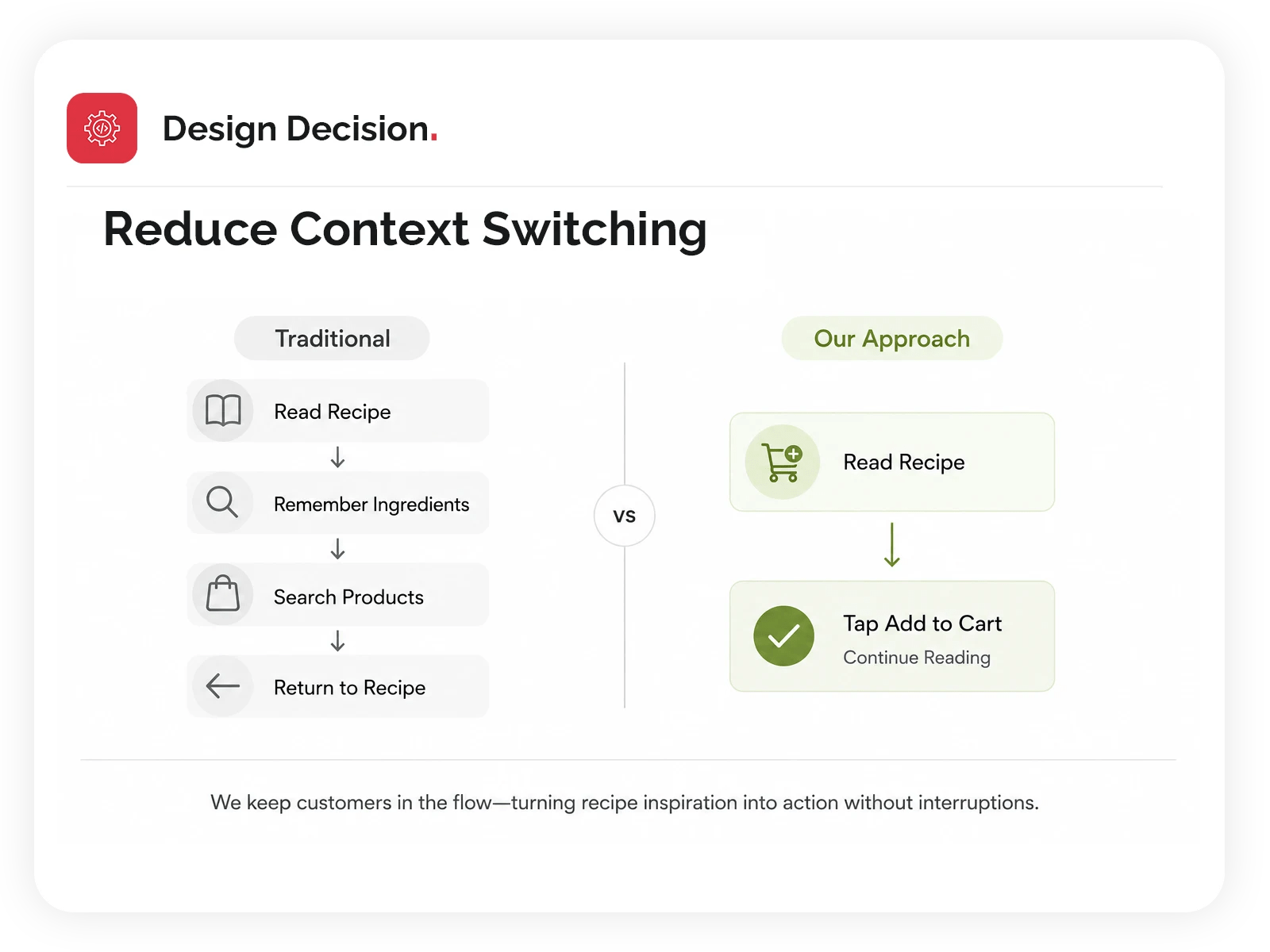
Most recipe pages are designed to be read. You discover a recipe you’d like to try. You scroll through the ingredients, mentally note what you need, leave the page, search for each product individually, add them one by one to your cart, then return to the recipe to continue.
It works. But it interrupts the experience.
When we designed the recipe section for Rasa Padhama, client asked a simple question:
What if the recipe itself became part of the shopping journey?
Instead of treating recipes as static articles, we treated every ingredient as a small interface connected directly to WooCommerce.
That single decision shaped everything that followed.

Rasa Padhama
Ecommerce
WordPress, WooCommerce, AJAX, Gutenberg, PHP
6 mins.
The Problem.
Recipes shouldn’t interrupt shopping.
Most ecommerce websites separate content from commerce. Recipes live in one part of the website. Products live somewhere else. Customers are expected to bridge that gap themselves.
Read. Remember. Search. Return.
Each step is small on its own, but together they create unnecessary friction.
Our goal wasn’t to redesign recipes. It was to remove the interruptions between inspiration and action.
Every Ingredient Became Interactive.
Ingredients react to what’s happening in the cart.
Turning an ingredient into an “Add to Cart” button sounds simple. It isn’t.
Every ingredient now needs to understand what’s happening elsewhere on the website. Before displaying anything, the system asks several questions.
- Is that product already in the cart?
- Should the interface show Add to Cart?
- Should it display Added?
- Or should it become Remove instead?
The ingredient is no longer just text inside an article. It’s an interface that reacts to the customer’s shopping session. Each ingredient quietly checks its own state before deciding what the customer should see.

Keeping Everything in Sync.
The recipe should always reflect the customer’s cart.
One of the biggest design decisions wasn’t visual. It was architectural.
The recipe page and the shopping cart should never behave like separate systems. When the page loads, every linked ingredient checks the customer’s current cart.
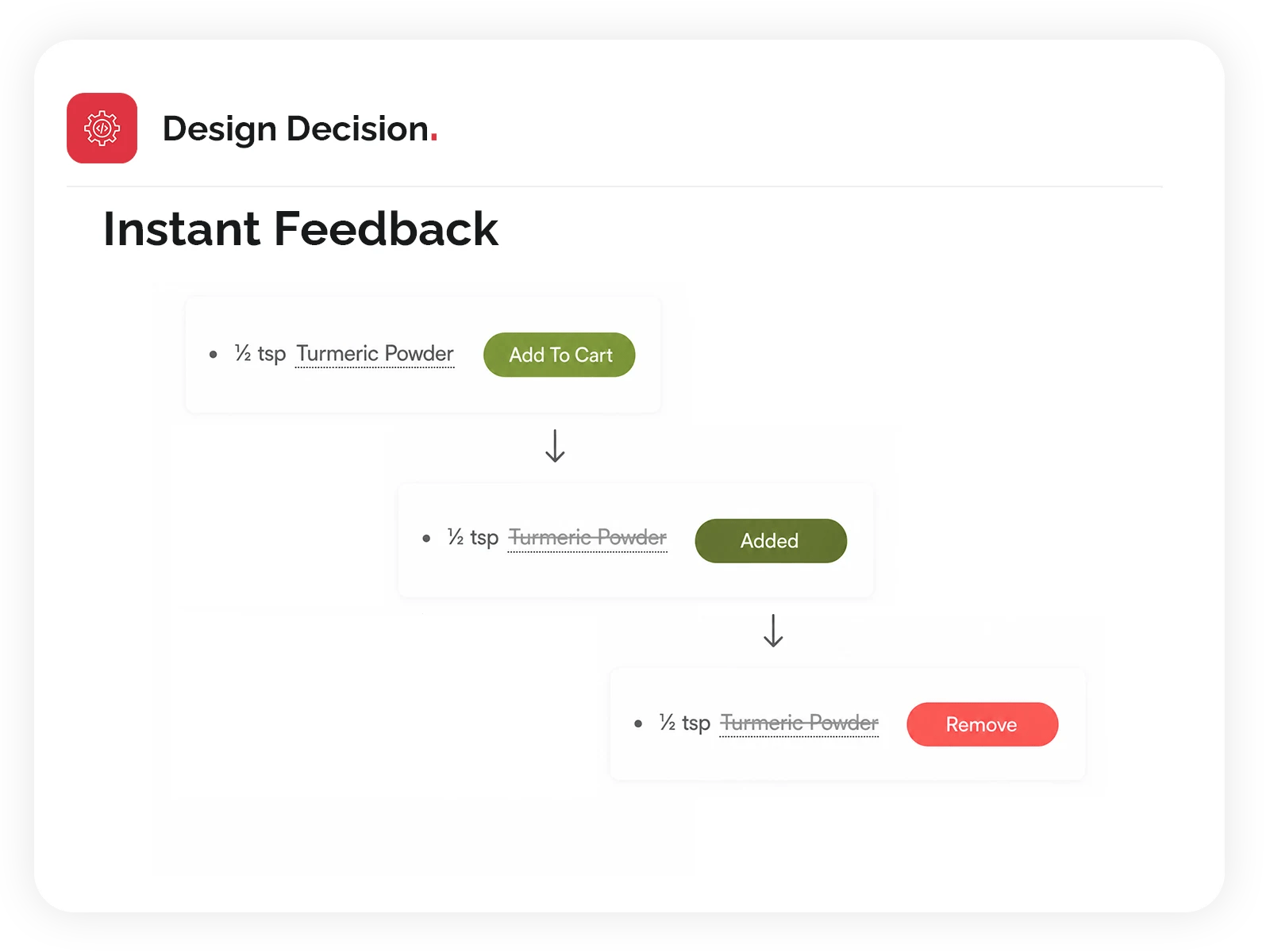
If turmeric is already there, the recipe immediately reflects that. The ingredient is struck through. The button changes to Remove. No duplicate products. No uncertainty. The same happens in reverse.
If a customer removes turmeric from the mini cart, the recipe instantly updates without reloading the page. The strike-through disappears. The Remove button becomes Add to Cart again.
The customer never has to wonder whether both parts of the website are showing the same information. They always are.

Instant Feedback.
Every interaction should feel immediate.
Good interfaces acknowledge an action immediately. Waiting even a second creates doubt.
Did it work? Should I tap again?
Instead of waiting for the mini cart to finish updating, we introduced a short transition.
The customer taps Add to Cart. The button immediately changes to Added.
Only after the cart has synchronized does it become Remove.
It’s a subtle interaction. Most people won’t consciously notice it. But they’ll feel it. The interface responds instantly, even while the rest of the system finishes its work in the background.
Designed For Content Authors.
Creating interactive recipes should feel effortless.
Customers weren’t the only users we designed for. Every recipe still has to be written by someone. Many implementations solve this with custom HTML, shortcodes, or complex editor settings. We wanted the opposite. Content authors should be able to create interactive recipes without thinking about the underlying engineering.
To achieve that, we built a custom Gutenberg block pattern. The editor simply inserts the ingredient block, selects the product using its Product ID, and publishes the article. Everything else happens automatically.
Product mapping. Interactive buttons. Live synchronization.
Future recipes can reuse exactly the same workflow without writing a single line of code. The complexity belongs in the platform, not in the editor.

The Small Details That Matter.
Great experiences are built one interaction at a time.
Not every engineering decision becomes a headline feature. Some exist only to make the experience feel more natural.
A subtle touch tint confirms that a button has been pressed.
An ingredient becomes struck through the moment it’s added.
The temporary Added state reassures the customer before synchronization completes.
The Remove button appears only when the cart is fully updated.
None of these interactions are revolutionary on their own. Together, they reduce hesitation, reinforce confidence, and make the interface feel responsive.
Good user experiences are rarely built around one big feature. They’re shaped by dozens of thoughtful decisions working together.


Final Thoughts.
For us, it wasn’t about adding buttons beside ingredients. It was about removing friction between inspiration and action. It’s a recipe that understands the customer’s cart, responds in real time, provides immediate feedback, and remains effortless for content authors to maintain. That’s the kind of engineering we enjoy building.
Let’s Engineer Something Remarkable.
Every digital experience is shaped by hundreds of decisions, from user experience and performance to the engineering that powers every interaction behind the scenes. Great products don’t happen by chance. They emerge through collaboration, curiosity, and a commitment to solving problems with purpose. We believe technology should do more than meet requirements. It should simplify workflows, delight users, and create lasting value for the businesses behind it. Whether you’re launching a new venture or refining an established platform, we’ll help transform your vision into a digital experience that’s intuitive, scalable, and built to grow with your ambitions.
Found this article useful?
July 21, 2026 @ 6:14 am
A great achievement indeed. Well done and creative work. I have never come across such an idea