
Epilogue – When the Work Speaks
When we began writing this final chapter in June, 2026, we thought we already knew how the story would end.
At the time, there was no reason to think otherwise. When we received the initial inquiry through our website, there was no discussion about awards. There were no conversations about industry recognition, design competitions, or national rankings. The objective was much simpler, and far more important. “Build a platform that solves real business problems.”
Looking back at the journey, it’s interesting how little of the final outcome could have been predicted during those first meetings.
What began as a conversation about replacing an existing ecommerce platform gradually evolved into something much larger. Along the way, we questioned familiar user experiences, rethought purchasing workflows, engineered a completely new buying model, adapted to changing market conditions, optimized the experience for real-world devices, and continuously refined the platform as new challenges emerged.
None of those decisions were made with judges in mind. They were made with customers in mind.
That distinction matters.
Throughout this series, we’ve shared the thinking behind many of the platform’s features. We’ve talked about removing unnecessary friction from the shopping experience, creating meaningful customer journeys, optimizing performance for everyday users, engineering Taste ePromise to address a genuine economic challenge, and adapting software when real-world supply constraints changed the rules.
On their own, these are simply individual engineering decisions.
Together, they became the foundation of a platform that reflected the client’s vision while demonstrating something we strongly believe:
Good software isn’t defined by the number of features it contains. It’s defined by how effectively those features solve real problems.
That philosophy has guided ideaGeek for years, and this project became one of the clearest examples of it in practice.
Recognition Was Never the Goal
The first surprise came in May.
The Rasa Padhama website was recognized as a TopWeb winner for May 2026, an achievement that eventually led to the website being shortlisted for the BestWeb.LK 2026 national awards.
Naturally, we were excited.
Recognition is always meaningful, especially when it acknowledges the countless decisions that rarely receive public attention.
Visitors notice a clean interface. Developers notice the architecture. Judges have the opportunity to recognize both.
For us, the shortlist represented more than an attractive website or a polished user interface. It reflected months of research, planning, collaboration, engineering, testing, optimization, and refinement coming together to create something that delivered genuine value to the business.
At that point, we thought we knew where this story was heading.
We didn’t.
In July, the shortlist became something much more significant.
Rasa Padhama was officially nominated in the Food & Beverage category at BestWeb.LK 2026, alongside two of Sri Lanka’s most recognizable names in the sector, Maliban Group and Imperial Teas Group. One is one of the country’s largest FMCG companies. The other is a globally recognized Sri Lankan tea exporter.
And alongside them was Rasa Padhama, a brand that began in 2020 during the COVID-19 lockdown, built around a traditional grinding mill in Gampola.
For everyone involved in the project, simply being in that category was already something worth celebrating.
But the story still wasn’t finished.

August 12, 2026
On August 12, at the BestWeb.LK 2026 awards night, the results were finally revealed.
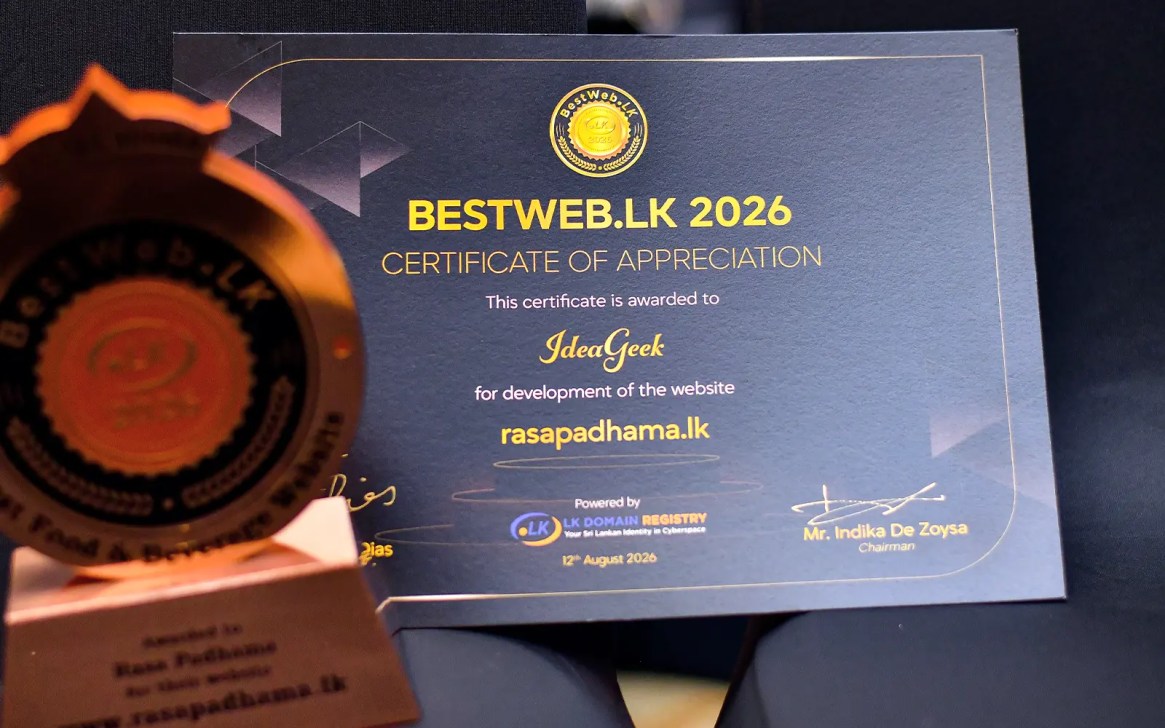
Rasa Padhama didn’t receive one award. It received TWO.
- Bronze Winner – Best Food & Beverage Website
- Winner – Best Mobile Optimized Website
The Food & Beverage recognition placed Rasa Padhama among the country’s leading digital experiences in the category.
But the second award carried a different kind of significance for us.
Best Mobile Optimized Website had a single winner – Rasa Padhama.
That recognition connected directly to one of the challenges we had spent considerable time solving throughout the project. The website wasn’t optimized for an ideal device sitting on a developer’s desk. It was engineered for the devices people actually use:
- Lower-spec mobile hardware.
- Variable network conditions.
- Smaller screens.
- Real customers navigating real purchasing journeys.
The performance work discussed earlier in this series wasn’t decoration. It wasn’t a final checklist item before launch. It was part of the engineering process. And seeing that work independently recognized was particularly meaningful.

Winner - Best Mobile Optimized Website

Bronze Winner - Best Food & Beverage Website
The awards belonged to Rasa Padhama. But the lessons belonged to us. They reinforced something we’ve always believed at ideaGeek:
When you focus on building the right solution, recognition can become a consequence of the work rather than the reason for it.
We didn’t build the platform to win an award. We built it because the client had problems worth solving. The recognition simply gave us another way to measure what that work had achieved.
The Real Achievement
If there’s one lesson this project reinforced, it’s that successful software is rarely the result of writing clever code. It begins much earlier. It begins by asking better questions. Every major feature in this project originated from a conversation.
- The loyalty program emerged while discussing long-term customer relationships.
- The recipe experience evolved by questioning why customers needed to search for ingredients they had already discovered.
- The configurable purchasing policies were born from a decision to redesign rather than patch.
- The mobile optimization work began by considering the realities of the people who would actually use the platform.
- Taste ePromise, the platform’s defining feature, started with a single question asked during a discovery meeting.
None of those ideas appeared because someone requested a specific plugin or technology. They emerged because everyone involved was focused on solving problems instead of collecting features. That’s a mindset we hope never changes.
- Technology evolves.
- Frameworks evolve.
- Programming languages evolve.
- The tools we use today may be replaced tomorrow.
But the ability to understand a business problem before writing a solution will always remain one of the most valuable skills a software team can develop.

The Awards Night
More Than a Website
Earlier in this series, we mentioned that this story wasn’t about building another online store. By the end of the project, that statement had become even more true than we initially imagined. The finished platform wasn’t simply a place where customers could purchase spices and groceries.
It became a digital ecosystem capable of supporting customer loyalty, content discovery, recipe-driven shopping, configurable business rules, future purchasing, and an administration experience designed to adapt as the business continued to grow.
Just as importantly, it gave the client something they hadn’t fully enjoyed before – Ownership.
The freedom to introduce new ideas without being constrained by someone else’s platform. For us, that’s one of the most rewarding outcomes any software project can achieve. Because the real measure of a successful digital platform isn’t how impressive it looks when it launches.
It’s what the business can do with it afterward.
Why We Started This Series
When we introduced this story in the Prologue, we said that portfolios usually show the destination, but rarely the journey.
We still believe that.
Behind every website is a collection of conversations that never appear in screenshots.
- There are sketches that never become designs.
- Ideas that are explored, challenged, and improved.
- Whiteboards filled with questions instead of answers.
- Late-stage redesigns prompted by changing business conditions.
- Engineering decisions that quietly make an experience feel effortless without ever asking users to notice them.
Those moments rarely receive the attention they deserve. Yet they’re often the moments that define a successful project.
That’s why we created idea Fueled™.
Not simply to showcase what we build, but to share how we think, how we solve problems, and how every meaningful project teaches us something new.
Rasa Padhama became the first story we chose to tell this way.
It began with a simple inquiry, became a complex engineering challenge that evolved through conversations, experiments, failures, revisions, and unexpected problems. And somewhere along the way, it became a platform that was recognized nationally, not once, but twice.
But the awards aren’t the part of the story we want to remember most. We want to remember the questions that came before them.
- The decisions nobody saw.
- The problems that forced us to rethink our assumptions.
- The moments when the simplest solution wasn’t good enough.
- And the moments when the work finally spoke for itself.

This is what idea Fueled™ was created to document. Not just what we build.
How we think.
This is the first story we’ve told. It certainly won’t be the last.
To everyone who followed this journey from the Prologue to the end, thank you for reading.
And to the team at Rasa Padhama, thank you for trusting us with your vision, challenging us to think differently, and allowing us to share a small part of the journey that brought it to life.
Some stories deserve more than a portfolio screenshot. We think this was one of them.
Sometimes, the best recognition isn’t something you build toward. It’s what happens when you build something worth recognizing.
Found this article useful?